“The most expensive revenue a business can pursue is new customer acquisition. The most profitable revenue is already standing inside your store—quietly disappearing at the seams where consultations turn into unanswered quotations.”
Your store may not have a footfall problem. It may have a conversion problem. And conversion is rarely just a sales team problem.
Across scaling consumer businesses and multi-format retail networks, executive teams routinely obsess over top-of-funnel levers: escalating digital marketing spends, signing prime high-street real estate leases, deepening seasonal discount margins, and expanding product assortments. But when revenue targets fall short, pouring more footfall into an uncalibrated store funnel simply accelerates cash burn.
The real leakage happens after the customer walks in.
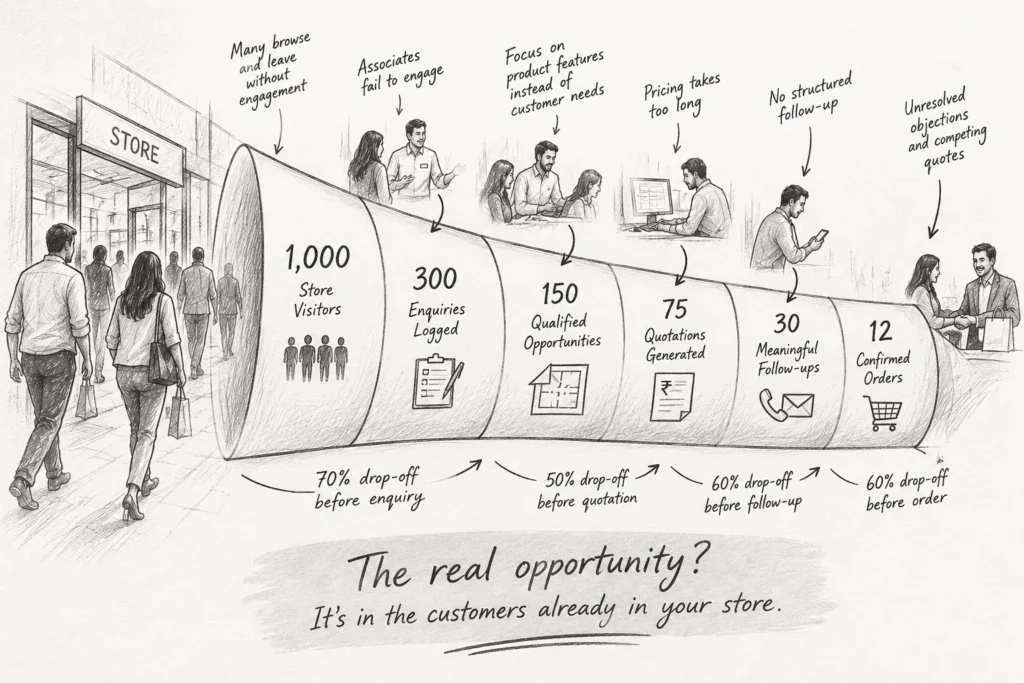
Consider a typical assisted-sales retail funnel: 1,000 visitors enter the store. 300 register an enquiry. 150 represent qualified opportunities. 75 receive formal quotations. 30 experience a meaningful follow-up conversation. And just 12 result in confirmed orders.
When founders and retail leaders see numbers like this, the reflexive executive question is: ‘Why aren’t we getting enough customers?’
The far more valuable, commercially grounding question is: ‘Where are we losing the customers we already have?’
I. Deconstructing the Leakage: The 1,000-to-12 Funnel Reality
In high-consideration and assisted-retail environments—furniture, premium electronics, lifestyle goods, custom apparel, and home improvement—sales do not happen instantaneously at a cash register. They require discovery, requirement mapping, pricing estimation, and post-visit follow-through.
Every stage of this journey represents an operational relay. When accountability between stages is ill-defined, buyer intent evaporates:
Funnel widths are illustrative, not to scale. The volumes are a representative example.
In this representative funnel, a business converts just 1.2% of its total visitors into paying customers. If that retailer doubles marketing spend to bring in 2,000 visitors, it simply generates 24 orders while abandoning 1,976 potential buyers. That is not growth; it is operational inefficiency subsidised by marketing capital.
II. The Science of Pipeline Latency: Why Delays Destroy Conversion
When leads and quotations stall, leadership often assumes the customer simply chose a competitor or changed their mind. Institutional sales research demonstrates that conversion drop-offs are overwhelmingly driven by process friction, response latency, and lack of follow-up discipline:
| Pipeline Friction Point | Reference Benchmark | Operational & Commercial Consequence |
|---|---|---|
| Quotation & Lead Response Latency | In a Harvard Business Review study of online sales leads, firms that responded within an hour were nearly seven times as likely to qualify the lead as firms that responded even an hour later, and more than 60 times as likely as firms that waited 24 hours or longer. (Harvard Business Review. The study covered online enquiries; the same speed principle is applied here to in-store quotations.) | Delays between an in-store consultation and quotation delivery cool buyer urgency, opening the door to competitors. |
| Quotation Follow-Up Abandonment | Widely quoted sales benchmarks suggest that roughly 48% of salespeople never follow up after first contact, and that most sales need around five follow-ups. (Industry rule of thumb; original source not verified.) | Businesses pour capital into generating store consultations, then allow a large share of their sent proposals to go dark. |
• Oldroyd, McElheran & Elkington, The Short Life of Online Sales Leads, Harvard Business Review, March 2011.
• HubSpot, Sales Statistics (carries the follow-up figures, attributed there to Invesp). These are widely repeated industry benchmarks; the original study could not be verified.
III. Why Conversion Is an Operating System Failure, Not a Sales Training Problem
When sales figures stagnate, the default corporate reaction is to organize a motivational sales training workshop. Store managers tell sales reps to ‘push harder,’ ‘close more aggressively,’ or ‘pitch value.’
This approach almost always fails. It fails because conversion leakage is rarely an individual salesperson’s capability problem. It is an operating system defect.
When an advisor begins diagnosing an underperforming retail floor, five operational failure patterns immediately surface:
- Uncaptured Enquiries: Walk-in shoppers who spend twenty minutes discussing custom options walk out the door without an associate recording their name, contact details, or project scope. When the customer leaves, the transaction dies.
- Flawed Requirement Discovery: Sales associates conduct product tours rather than structured discovery. They cannot diagnose the customer’s true timeline, budget parameters, or functional constraints, leading to mismatched proposals.
- Quotation Turnaround Latency: Frontline associates do not control pricing calculations. They rely on estimating desks, warehouse teams, or technical designers who take 72 hours to turn around a quote. In the mind of the buyer, delay signals disorganization.
- Orphaned Quotations: Quotations are emailed as passive PDF attachments with zero agreed next action. No calendar invite is placed, no review consultation is booked, and no follow-up cadence is triggered.
- Multi-Team Dependency Bottlenecks: Frontline staff are stuck in escalation limbo. They cannot answer delivery, customization, or stock questions because back-office teams have not responded. The customer gets tired of waiting and moves to a competitor.
These are not isolated behavioral quirks. Together, they constitute a broken operating system. You cannot train an associate to overcome a multi-departmental bottleneck with motivational speaking.
IV. Four Operational Levers to Plug Funnel Leakage
Transforming in-store conversion requires looking at the complete commercial relay: Visitor → Enquiry → Qualification → Consultation → Quote → Follow-up → Order → Delivery → Repeat.
To plug the leaks across this chain, retail leadership must implement four concrete operational disciplines:
1. Mandate Enquiry Capture at Point of Intent
Treat walk-in consultations as registered business opportunities, not casual store visits. Implement an intuitive digital capture mechanism at the store floor level. Every customer who engages in a meaningful discussion regarding pricing, dimensions, or specifications must be logged with specific project requirements before leaving.
2. Enforce Strict Quotation Turnaround SLAs
Quotation delays kill conversion. Establish non-negotiable Service-Level Agreements (SLAs) between retail store staff, estimating desks, and technical design teams. In high-performing operations, standard quotations are generated within 4 business hours, and complex custom proposals within 24 hours.
3. Establish Single-Point Follow-Up Ownership
Eliminate ‘shared store responsibility.’ When a quote is issued, a single designated sales consultant must own the outcome end-to-end. Furthermore, no quotation should ever be dispatched without an agreed next milestone: a scheduled follow-up call, a virtual review meeting, or an in-store sample validation.
4. Build Real-Time Pipeline Visibility
Replace lagging monthly revenue post-mortems with leading weekly operational pipeline reviews. Store managers should not ask, ‘How much revenue did we bill this weekend?’ They must ask:
Enquiry Volume: How many walk-in consultations were captured across our floors this week?
Quotation Aging: How many quotations are currently sitting past our 24-hour delivery SLA?
Pipeline Hygiene: How many open proposals have gone past 7 days without a documented customer follow-up touchpoint?
V. The In-Store Funnel Diagnostic: Questions Leaders Must Ask
Before deploying additional acquisition marketing or opening new store locations, audit your current operating funnel against this diagnostic matrix:
| Funnel Transition Point | Operational Reality Check | Strategic Risk if Unaddressed |
|---|---|---|
| Visitor → Enquiry | Do store hosts actively engage and log customer intent, or do shoppers wander unassisted and leave without a record? | 70% of potential buyers walk out uncaptured, wasting acquisition capital. |
| Enquiry → Opportunity | Does the associate follow a structured requirement discovery protocol, or merely recite catalog specifications? | Poorly qualified opportunities yield mismatched proposals and wasted effort. |
| Opportunity → Quote | Are quotations delivered within 4 to 24 hours, or delayed by internal estimation handoffs and pricing desks? | Lead urgency fades, momentum dies, and competitors capture the deal. |
| Quote → Follow-Up | Is every sent quote attached to a single owner with a scheduled next review date, or left as an orphaned PDF? | Many sent quotations go dark with zero proactive contact. |
| Follow-Up → Closed Order | Do store managers conduct weekly pipeline reviews on aging quotes, or only track billing at month-end? | Lack of visibility prevents leadership from unblocking stalled transactions. |
VI. Scaling Beyond Founder Bandwidth: Finding Growth from Within
In the early days of a retail or consumer brand, founders close the conversion gap through raw personal intervention. A founder stands in the flagship store, catches slipping deals, speeds up pricing estimates personally, and calls customers directly to follow up.
But as the business expands across multiple formats and geographies, the founder cannot be on every store floor. Without an underlying operating system, conversion collapses, marketing efficiency plunges, and leadership becomes overwhelmed by daily firefighting.
Sustainable commercial growth does not come from endlessly chasing more top-of-funnel footfall. It comes from building a repeatable, visible operating cadence that prevents good customer demand from slipping through internal seams.
Fix the leaks. Make ownership non-negotiable. Establish pipeline visibility. Build a repeatable operating process. Then measure what changes.
Where is the biggest leakage occurring in your store operations today?
Uncaptured walk-in intent, quotation turnaround delays, or abandoned follow-ups? If you are scaling a consumer or retail business and suspect your operating system is preventing good customer demand from becoming revenue, let us connect for a focused In-Store Funnel & Conversion Leakage Audit.
Start a Focused Discussion →